Attack on the Collini Family and Burning of Their Farm
The Collini CaseThe Attack on the Collini Family and Burning of Their Farm is the defining childhood catastrophe in Fabrizio Collini’s history: German soldiers take his father, a soldier returns to the family farm, and Collini’s sister dies during the ensuing attack. The farm is later reported burned. The event is first rendered through a child’s confused observations, then recounted in court by Caspar Leinen, where the private destruction of one family becomes part of a wider reckoning with wartime violence and its legacy.
Background and the father’s disappearance
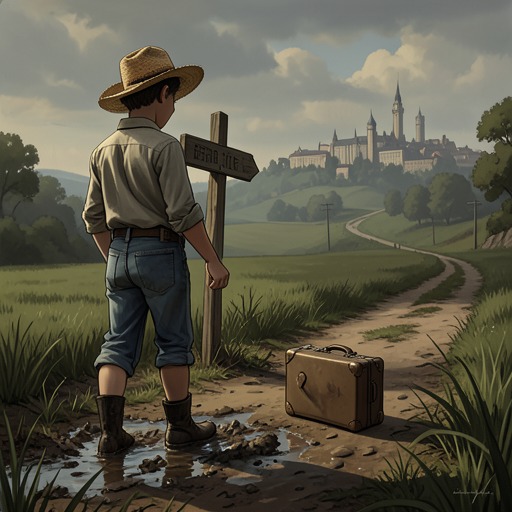
Fabrizio is a child on his father’s farm in wartime Italy. His mother died when he was born, leaving him and his sister with their father as their immediate family. The war has already taken his father’s two brothers, who died fighting in the Italian campaign against Greece. Fabrizio scarcely remembers them, but remembers his father grieving and repeating that war was madness. He knows the word without understanding its full meaning.
The occupation is present in the surrounding details: German uniforms, reports from visiting relatives in Genoa that the Germans are taking what they need from the factories, and adult whispers about partisans and assassination attempts. The children’s games change from cops and robbers to partisans and Germans. Some evenings, Fabrizio’s father puts on a grey coat and beret and leaves the farm; his sister tells Fabrizio that their father is a partisan. The children’s home is thus already caught between ordinary family life and a conflict they cannot fully comprehend.
One day Fabrizio returns from his ride to find his sister crying at the farm entrance. She tells him that the Germans have taken their father. They go inside, where she mechanically prepares food, but does not eat. She plans to take Fabrizio to their only living relation, their maternal uncle Mauro, whose farm is almost ten kilometres away. Before they can leave, she sees a German military vehicle returning. A single soldier is at the wheel.
The attack and escape
At his sister’s urging, Fabrizio runs across the farmyard and hides in a large, long-empty dog kennel, wrapped in a dirty, torn blanket. From a gap in the boards he sees the jeep’s tyres and the soldier’s boots stop, turn, and head toward the house. When he hears his sister scream, he leaves his hiding place and goes back to the kitchen. He finds her in danger from the soldier, who has a pistol. The passage stays close to the boy’s bewildered viewpoint: he recognizes the man’s military badge and notices a jagged scar on his forehead, but cannot make sense of what he sees.
Fabrizio screams. In the sudden movement that follows, the pistol catches on his sister’s gold chain and discharges. The shot kills her. The locket on the chain, showing the Virgin Mary, had been a gift from their mother; in the same room, Fabrizio also sees his father’s tobacco tin on the kitchen shelf. Its lid shows two Red Indians seated beside a campfire, an image associated with the evenings when his father rolled cigarettes and talked with the children. The familiar objects remain in place while the family around them is destroyed. Fabrizio stops screaming, looks at the soldier, and then understands that he must flee.
He runs past the kennel and pond, through the pine forest, across a narrow bridge, and along a woodland path toward his uncle’s farm. He slips on the wet paving stones and hurts his knee, but keeps going. At the house he stammers out what happened; his uncle takes a shotgun from a cupboard and drives out. The account does not show the rescue or the burning itself. Its aftermath is delivered later, when Mauro tells Fabrizio that the farm has been burned down and his sister is dead. Fabrizio asks whether she was burned too, and Mauro answers yes.
The event in the courtroom
Years later, Leinen reads aloud a statement based on what Collini has told him and what he has found in files in Ludwigsburg. His first major plea is delivered in the dry language of law, slowly and with little emphasis. As the statement proceeds, however, the courtroom’s understanding shifts: its sentences bring people, landscapes, and towns before the listeners. Leinen himself recognizes, through this act of presenting the history, that criminal proceedings concern abused human beings, not merely the interpretation of legal rules.
That shift makes the family’s loss more than background to the murder trial. After Richard Mattinger has spoken in court, Leinen passes reporters, leaves his briefcase in a side street, and finds a memorial in a small park near the courthouse. The plaque bears the line, “Madness alone was lord of all this land.” The accompanying memorial names people who died in the war’s final days in different circumstances. Sitting there, Leinen reflects that the war has remained distant to him despite his father’s accounts, the books and films he has encountered, and years of lessons about the Third Reich period. The courtroom’s account of the Collini family has made that distance harder to maintain.
Historical and public consequences
The history also changes how the legal dispute is framed. Leinen points out that Collini’s father was killed for a second time, in effect, when Mattinger’s arguments reduced the past to a matter set apart from the present case. During the trial, Leinen links the question of guilt to the statute of limitations and the law that came into force on 1 October 1968. Mattinger objects that discussion of the Bundestag and the past turns the hearing into a history lecture; Leinen answers that the circumstances do not alter the fact that Collini killed a man, but that arbitrariness and comprehensibility matter to the question of guilt. The family’s wartime experience therefore enters the courtroom not as an excuse that erases the killing, but as history relevant to how the act is understood.
The novel’s public afterlife extends this argument beyond the courtroom. In January 2012, a few months after its original German publication, the Federal Minister of Justice appointed a committee to reassess the imprint of the Nazi past on the Ministry of Justice. The novel became one of the committee’s points of reference. In that context, the attack and the reported burning of the farm stand both as a specific family’s irreparable loss and as part of a broader examination of how institutions and society confront wartime crimes. The child’s flight from the farm leads, much later, to a legal and public dispute over what the past means; the event’s consequences persist even where the original violence cannot be undone.